Overview
Peregrine is an open-source security research harness for smart contracts. It is completely model agnostic.
Think of it as Codex Security or Cloud Code Security, purpose-built for smart contract auditing. Peregrine includes domain-specific tooling, audit skills, and persistent memory out of the box.
Peregrine combines agentic workflows with specialized security tooling to help raw model intelligence find real vulnerabilities rather than only generating observations.
Inspect the actual compiled bytecode, decompilations, and control-flow structures live alongside the agent’s analysis.
BYOM
Peregrine is completely model-agnostic. You bring your own model.
Frontier models deliver leading performance and broad capabilities with no infrastructure to manage.
Open-source models can cost up to 40 times less. You self-host them for full control. They avoid arbitrary slowdowns, quality degradation, and cyber use-case restrictions.
Connect any OpenAI Responses-compatible endpoint or custom provider. You control the model, the hosting, and the access policy.
Weigh performance, cost, privacy, and compliance to decide what works best.
Persistent audit memory
Peregrine separates intelligence from memory. It builds on Memory Walrus to give agents a durable security workspace.
Project context, hypotheses, tool outputs, verification artifacts, and findings persist beyond individual sessions.
Agents can change. Models can change. The audit memory remains. Investigations continue seamlessly across providers and over time.
Custom agentic workflow
Peregrine is built for autonomy. You can launch an audit and let it handle the complete flow on its own—from planning the strategy through analysis and validation all the way to the final report. Or you can steer it by reviewing plans, guiding direction, and intervening as needed.
Peregrine drives audits with a custom agentic workflow built on plan mode and goal mode.
When you want to steer, you launch an audit plan. Peregrine uses plan mode to inspect the target, discover available analysis tools, and produce a complete strategy for you to review and approve. The workflow performs no execution until you give explicit approval.
For full autonomy you can start the audit directly. Peregrine plans and executes the work without requiring your review at each step.
Once the audit is running, goal mode maintains the top-level objective and tracks progress. The orchestrator and specialist sub-agents read from and update the active goal so every participant stays aligned on what the audit must achieve. The goal lives in the durable workspace, which lets the workflow resume cleanly across pauses, model changes, or agent restarts.
The orchestrator sequences the work and brings in the right specialists only when their contribution advances the current goal. You see the plan, the goal updates, and the accumulating evidence directly in the audit session.
See the Audit workflow page for the planning and execution steps. See Subagents for how the orchestrator coordinates the specialist roles.
Where you can use Peregrine
Choose the interface that fits your workflow. Peregrine delivers the same autonomous agent capabilities everywhere.
Desktop app
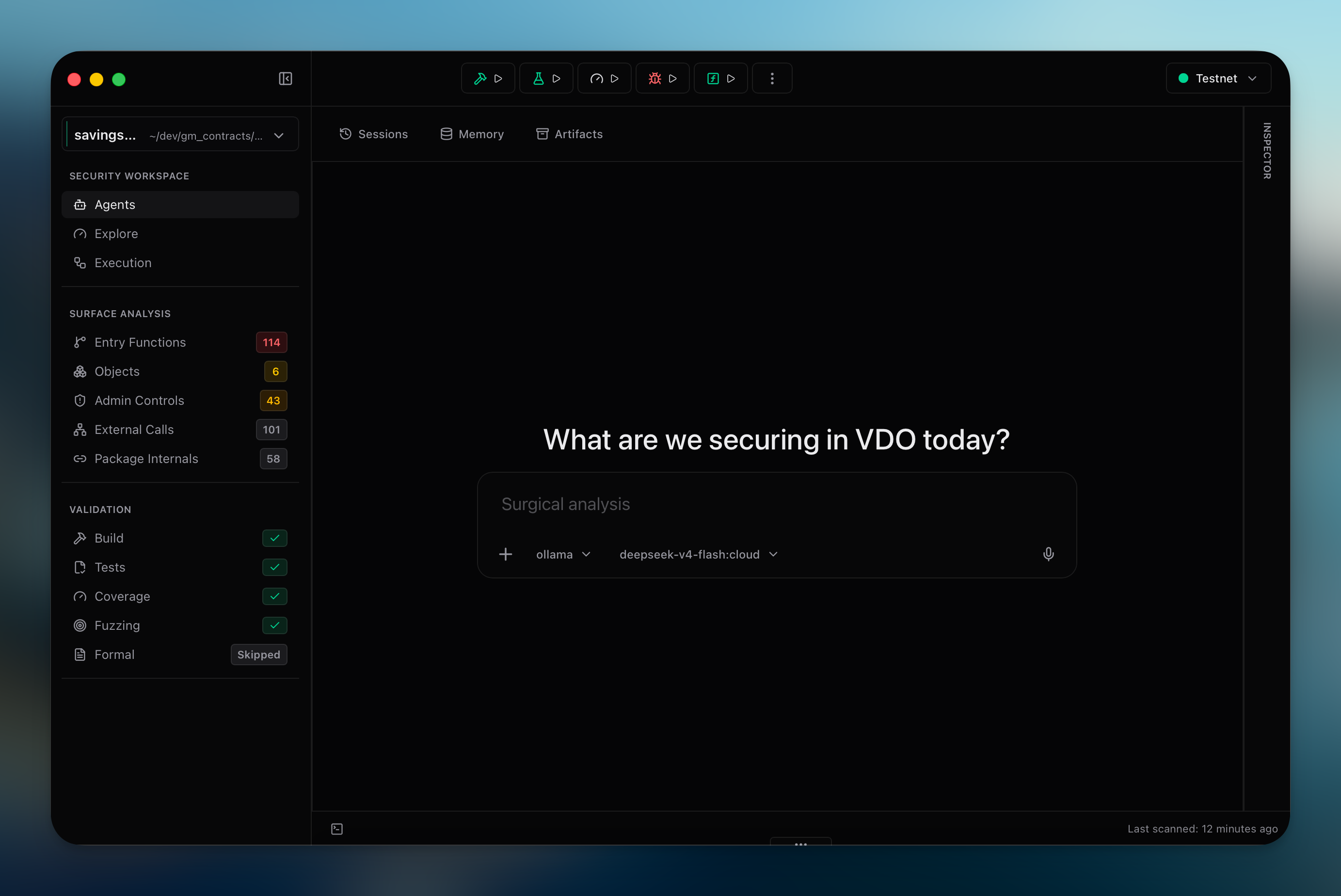
The desktop app gives you a rich graphical environment for deep security research.
It includes:
- Project workspace with Move package management and load assessments
- Built-in code editor with full LSP support for the Move language
- Bytecode viewer, decompiler, and control-flow inspection
- Interactive dependency graphs, call graphs, and type graphs
- Execution builder and integrated terminal dock
- Agent workflow canvas and specialized audit agents (Researcher, Exploiter, Skeptic, Judge)
- Real-time indexer, surface analysis, and module signatures
Stay inside one environment from initial exploration to final report.
TUI
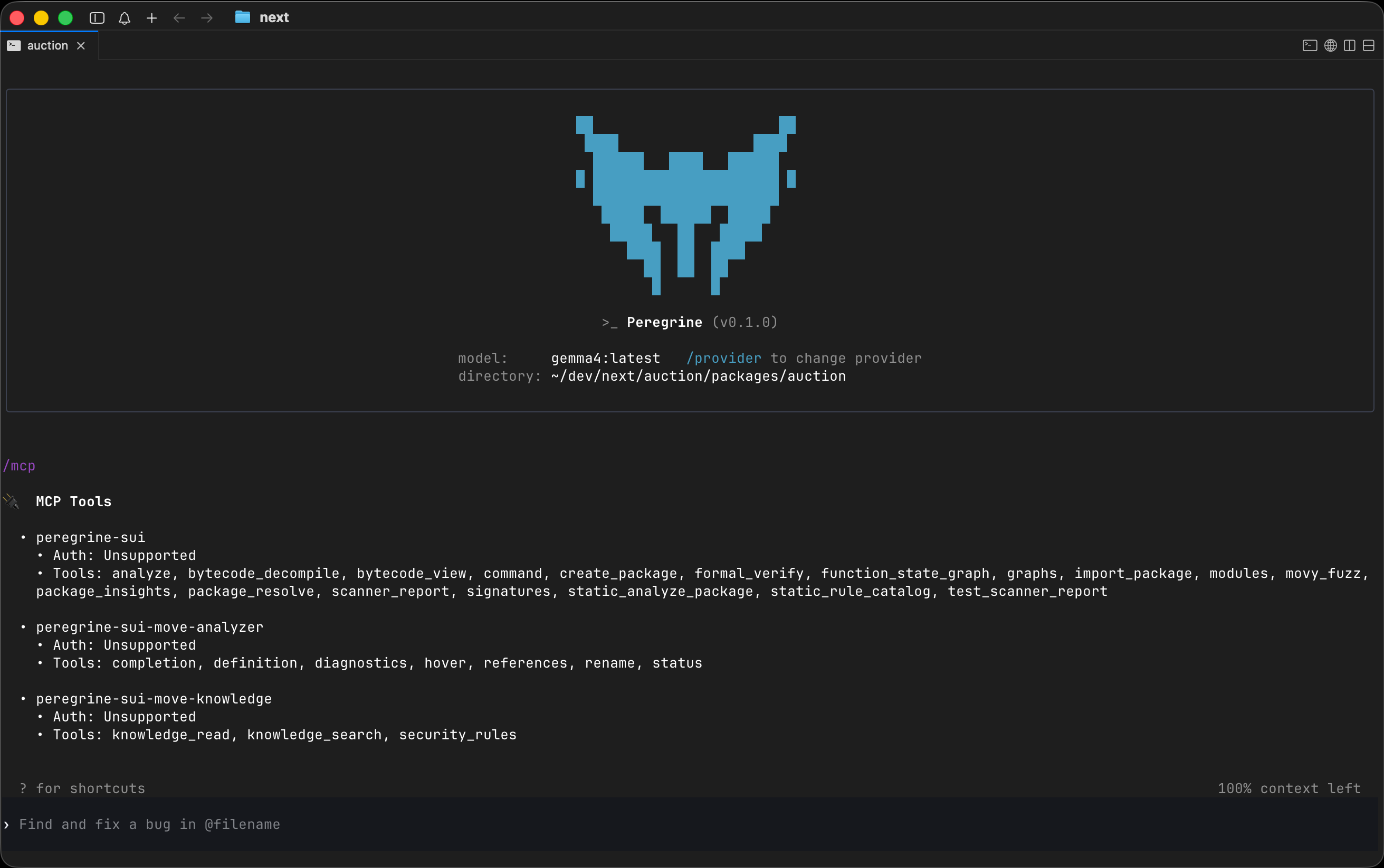
The TUI delivers fast, keyboard-centric access directly in your terminal. You start with the peregrine command and use slash commands to launch audits, interact with agents, manage sessions, and steer the workflow. It excels for scripting, headless runs, and quick iterations.
IDE integration
Bring Peregrine’s analysis and agent power into your existing editor. The Move analyzer LSP and MCP tools provide bytecode inspection, security queries, and agent assistance inside VS Code, Cursor, and compatible IDEs without switching contexts.
As an SDK
Embed Peregrine’s engine, memory system, tools, and agents into your own applications. Rust crates and JavaScript runtimes let you build custom security tools, CI integrations, or specialized agentic workflows while reusing the core orchestration and memory layers.